










If there is one experience that belongs on almost every first trip to Vietnam, it is eating on the street.
Vietnam Street Food is everywhere: steaming noodle stalls opening before sunrise, bánh mì carts squeezed onto busy corners, tiny restaurants hidden down alleys and plastic stools filling the pavement after sunset.
And street food in Vietnam is about much more than finding an inexpensive meal.
It is one of the easiest ways to experience everyday Vietnamese life.
Food changes dramatically as you travel from north to south. Northern cuisine tends to emphasize more subtle flavors, Central Vietnam is known for stronger seasonings and distinctive sauces, while Southern dishes often lean sweeter and draw on a wide range of regional influences. Vietnam Tourism likewise emphasizes how strongly dishes vary across the country’s regions.
For a first-time visitor, however, the sheer number of dishes can be overwhelming.
Where should you start?
From bowls of phở in Hanoi and smoky bún chả to cao lầu in Hoi An, bún bò Huế and late-night cơm tấm in Ho Chi Minh City, these are 15 Vietnamese street foods worth looking for as you travel through the country.
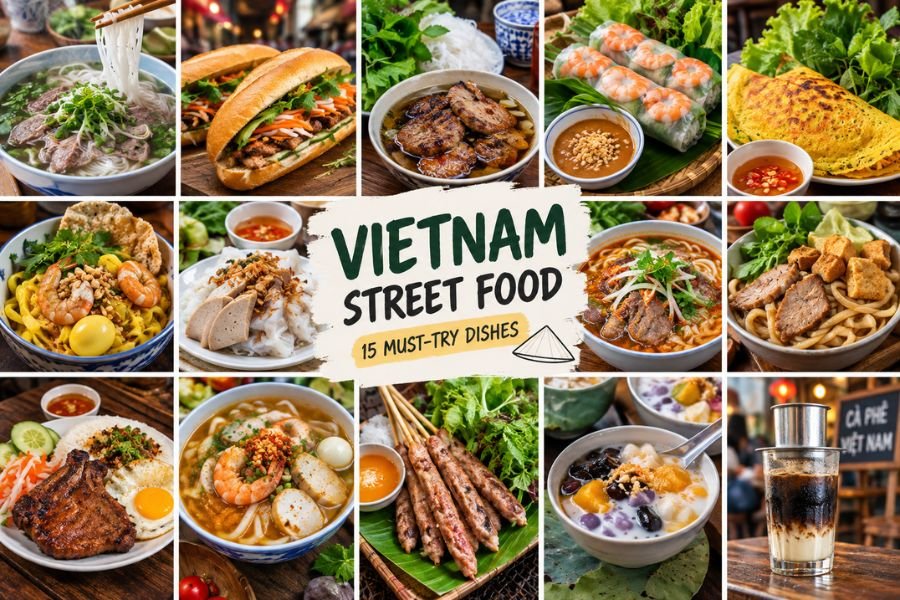
Vietnam Street Food at a Glance
| Dish | What Is It? | Where to Try |
|---|---|---|
| Phở | Rice noodle soup | Hanoi & nationwide |
| Bánh mì | Vietnamese filled baguette | Nationwide |
| Bún chả | Grilled pork with rice noodles | Hanoi |
| Bánh cuốn | Steamed rice rolls | Northern Vietnam |
| Xôi | Sticky rice | Nationwide |
| Bún bò Huế | Spicy beef noodle soup | Hue |
| Mì Quảng | Quang-style noodles | Da Nang & Quang Nam |
| Cao lầu | Hoi An noodle dish | Hoi An |
| Bánh xèo | Crispy savory pancake | Central & Southern Vietnam |
| Nem lụi | Grilled meat skewers | Hue & Central Vietnam |
| Cơm tấm | Broken rice with grilled pork | Ho Chi Minh City |
| Hủ tiếu | Southern noodle soup | Southern Vietnam |
| Gỏi cuốn | Fresh spring rolls | Southern Vietnam & nationwide |
| Ốc | Snails and shellfish | Ho Chi Minh City |
| Chè | Sweet dessert | Nationwide |
Don’t treat this as a checklist that must be completed.
The best approach to Vietnam Street Food is often to try regional specialties where they belong.
1. Phở – Vietnam’s Most Famous Noodle Soup
You may have eaten phở before arriving in Vietnam.
Eat it again.
A traditional bowl combines flat rice noodles with an aromatic broth and usually beef (phở bò) or chicken (phở gà). Herbs, lime, chili and other condiments may be served alongside depending on where you are.
Vietnam Tourism describes phở as one of the country’s quintessential dishes, traditionally pairing flat rice noodles with beef or chicken and a deeply flavored stock.
Where to Try Phở
Hanoi is an excellent place to start.
Northern-style phở tends to let the broth take center stage, so taste it before automatically adding sauces.
You’ll see phở shops busy from early morning because noodle soup is a perfectly normal Vietnamese breakfast.
First-timer tip: Don’t wait until lunch to search for every famous breakfast stall. Many local food businesses operate around specific meal periods.
2. Bánh Mì – The Ultimate Vietnamese Street Sandwich
Few Vietnamese foods are easier to fall in love with than bánh mì.
The foundation is a light, crisp baguette, but what goes inside varies enormously.
You may encounter pâté, pork, Vietnamese cold cuts, grilled meat, egg, cucumber, pickled vegetables, herbs, chili and house sauces.
Every vendor seems to have a slightly different version.
That’s part of the fun.
Where to Try Bánh Mì
You can find bánh mì almost everywhere in Vietnam, including Hanoi, Hoi An, Da Nang and Ho Chi Minh City.
It works equally well as breakfast, a quick lunch or an afternoon snack.
For first-time visitors nervous about ordering street food, bánh mì is also one of the easiest places to begin.
Point to the filling you want and watch the sandwich being assembled in front of you.
3. Bún Chả – A Hanoi Essential
If you’re visiting Hanoi, make room for bún chả.
The dish typically brings together charcoal-grilled pork, rice vermicelli, fresh herbs and a bowl of savory-sweet dipping liquid.
Rather than mixing everything immediately, diners can combine noodles, herbs and pork as they eat.
The aroma is part of the experience.
Walk around Hanoi near lunchtime and you may smell the pork grilling before you even see the restaurant.
Vietnam’s official tourism site lists bún chả among Hanoi’s characteristic street foods and regional specialties.
Where to Try Bún Chả
Hanoi.
This is one of those dishes that makes most sense in the city where it is deeply embedded in local food culture.
Pair it with nem cua bể — crispy crab spring rolls — if available.
4. Bánh Cuốn – Delicate Steamed Rice Rolls
Bánh cuốn proves that Vietnamese street food doesn’t need to be heavy or intensely spicy to be memorable.
Thin sheets of steamed rice batter are rolled around a savory filling, often including minced pork and wood ear mushrooms.
They’re commonly served with herbs, fried shallots and dipping sauce.
The result is soft, delicate and surprisingly satisfying.
Where to Try Bánh Cuốn
Look for it in Hanoi and Northern Vietnam, particularly in the morning.
One of the pleasures is watching vendors make each rice sheet fresh over a steaming cloth-covered pot.
5. Xôi – Vietnamese Sticky Rice
Street food isn’t only noodles.
Xôi, or sticky rice, is one of Vietnam’s classic quick meals.
Versions range from simple sticky rice with peanuts or mung beans to substantial bowls topped with meat, egg, sausage or fried shallots.
It is portable, filling and commonly eaten for breakfast.
Why First-Time Visitors Should Try It
Xôi offers a glimpse of everyday Vietnamese food beyond the dishes most commonly exported abroad.
If you’re leaving early for a train, bus or day trip, it can also make an extremely convenient breakfast.
6. Bún Bò Huế – A Bowl With Serious Character
Travel into Central Vietnam and the flavors begin to change.
Bún bò Huế is closely associated with the former imperial capital of Hue.
The noodle soup combines thick round rice noodles with a rich, aromatic broth and commonly beef, herbs and other accompaniments. Its flavor profile is more assertive than the lighter broths many travelers associate with phở.
Vietnam Tourism identifies bún bò Huế as one of the country’s essential noodle dishes and connects it directly with Hue’s distinctive culinary heritage.
Where to Try Bún Bò Huế
Hue, naturally.
Try it in the morning if you want to experience it closer to the way many locals do.
And don’t assume breakfast in Vietnam should be light.
A steaming bowl of noodles before 9 a.m. is completely normal.
7. Mì Quảng – Central Vietnam in a Bowl
Mì Quảng looks like noodle soup until you notice there is surprisingly little broth.
That is intentional.
The dish uses broad rice noodles with a concentrated amount of flavorful broth and can include pork, chicken, shrimp, egg, herbs, peanuts and crispy rice crackers.
Vietnam Tourism describes mì Quảng as a Central Vietnamese specialty using flat yellow or white rice noodles, a small amount of rich broth, fresh herbs and toppings that vary from pork and chicken to shrimp and fish.
Where to Try Mì Quảng
Look for it in Da Nang and Quang Nam, including around Hoi An.
Central Vietnam has a particularly strong relationship with sauces, seafood and intensely flavored accompaniments, so don’t rush through this region’s food scene.
8. Cao Lầu – The Dish You Should Eat in Hoi An
Some foods are closely tied to a place.
Cao lầu is one of them.
This Hoi An specialty combines chewy noodles with slices of pork, greens, herbs and crunchy elements.
It is neither a typical noodle soup nor a dry noodle dish in the usual sense.
And that’s precisely why you should try it.
Where to Try Cao Lầu
Hoi An Ancient Town.
Rather than looking for cao lầu everywhere else in Vietnam, save this experience for Hoi An.
Our Hoi An Travel Guide can help you combine the Ancient Town’s food scene with its markets, historic streets and surrounding countryside.
9. Bánh Xèo – Crispy Vietnamese Pancakes
You’ll often hear bánh xèo before you see it.
The name is commonly associated with the sizzling sound of batter hitting a hot pan.
The crispy savory pancake may contain pork, shrimp and bean sprouts and is usually eaten with herbs and greens.
Instead of attacking it with a knife and fork, follow the local style: break off a section, combine it with greens or rice paper where provided, then dip it into the accompanying sauce.
Where to Try Bánh Xèo
You’ll find regional versions across Central and Southern Vietnam.
Sizes, fillings and dipping sauces vary by location, which makes bánh xèo an interesting dish to try more than once during a longer trip.
10. Nem Lụi – Grilled Skewers Made for Dipping
Central Vietnam knows how to make dipping sauces matter.
Nem lụi consists of seasoned meat grilled on skewers and typically served with rice paper, herbs, vegetables and dipping sauce.
Part of the experience is assembling each bite yourself.
Add the meat.
Add fresh herbs.
Roll.
Dip.
Repeat.
Where to Try Nem Lụi
Hue is an excellent place to look for it.
It’s particularly enjoyable as a shared meal when you want something more interactive than a bowl of noodles.
11. Cơm Tấm – Ho Chi Minh City’s Everyday Classic
Arrive in Ho Chi Minh City and you’ll soon notice plates of rice topped with smoky grilled pork.
This is cơm tấm, or broken rice.
The dish grew from humble origins but has become one of Southern Vietnam’s signature foods. A typical serving may include grilled pork, egg, pickled vegetables and other accompaniments with fish sauce on the side.
Vietnam Tourism highlights cơm tấm as a Southern specialty that can be eaten at breakfast, lunch or dinner.
Where to Try Cơm Tấm
Ho Chi Minh City.
For travelers who want to explore the city beyond its food scene, our Things to Do in Ho Chi Minh City guide can help you plan the rest of your stay.
12. Hủ Tiếu – A Southern Vietnamese Favorite
Hủ tiếu doesn’t receive the same international attention as phở, but in Southern Vietnam it is everywhere.
Different versions can come with pork, seafood, minced meat and other toppings.
You may encounter it as a soup (hủ tiếu nước) or with the broth served separately (hủ tiếu khô).
Where to Try Hủ Tiếu
Ho Chi Minh City and the Mekong Delta are good places to explore different versions.
It is exactly the kind of dish worth ordering when you want to move beyond Vietnam’s globally famous foods and eat something deeply familiar to local diners.
13. Gỏi Cuốn – Fresh Vietnamese Spring Rolls
After several bowls of noodles and plates of grilled meat, gỏi cuốn can feel wonderfully refreshing.
Often translated as fresh spring rolls, they typically wrap rice vermicelli, herbs and other fillings inside translucent rice paper.
Unlike fried spring rolls, these are fresh and soft.
They are usually served with a dipping sauce, which can vary by region and vendor.
Where to Try Gỏi Cuốn
They are particularly associated with Southern Vietnamese cuisine but are widely available.
They’re also a useful reminder of how central fresh herbs and contrasting textures are to Vietnamese cooking.
14. Ốc – A Ho Chi Minh City Night Out on a Plate
If you want to experience the social side of Vietnam Street Food, spend an evening eating ốc in Ho Chi Minh City.
“Ốc” broadly covers snails and a variety of shellfish prepared in countless ways.
They may be grilled, steamed, boiled or stir-fried with sauces ranging from garlic and chili to tamarind and coconut-based flavors.
Vietnam Tourism describes ốc as a quintessential Ho Chi Minh City street-food experience, with shellfish prepared using several different cooking techniques and bold sauces.
How to Eat Ốc
Don’t rush.
Ốc is as much a social activity as a meal.
Order several dishes for the table, share them and enjoy the process.
For many travelers, this is one of the experiences that makes Southern Vietnamese street culture memorable.
15. Chè – End With Something Sweet
You have eaten the noodles.
You have eaten the grilled pork.
There is still room for dessert.
Chè refers to a broad family of Vietnamese sweet dishes rather than one fixed recipe.
Depending on the version, you might encounter beans, jelly, fruit, sticky rice, coconut milk or crushed ice.
Some are served warm.
Others arrive icy cold.
Where to Try Chè
Almost anywhere.
Because varieties change from region to region, chè is another food worth trying more than once as you travel through Vietnam.
Vietnam Street Food Changes From North to South
One of the biggest mistakes first-time visitors make is thinking of Vietnamese cuisine as a single, uniform food culture.
It isn’t.
Northern Vietnam
Northern cuisine often emphasizes balance and more restrained seasoning.
Hanoi is an excellent place for phở, bún chả and bánh cuốn.
Central Vietnam
Central cuisine often delivers stronger flavors, sauces and distinctive regional recipes.
Think bún bò Huế, mì Quảng, cao lầu and nem lụi.
Vietnam Tourism particularly notes the importance of sauces and seafood in Central Vietnamese cooking.
Southern Vietnam
Southern Vietnamese cuisine absorbs influences from across the country and often features sweeter flavor profiles.
Cơm tấm, hủ tiếu, gỏi cuốn and ốc are excellent places to begin.
This regional diversity is why food deserves to be part of your itinerary rather than something you plan only after choosing destinations.
How to Choose a Good Vietnam Street Food Stall
You don’t need to find a famous restaurant every time you eat.
Some of the best meals may come from a tiny stall you never planned to visit.
Vietnam Tourism suggests looking for stalls that appear clean and organized, use fresh-looking ingredients and attract plenty of local customers.
A busy stall can also mean ingredients are turning over quickly.
Pay attention to what people around you are ordering.
Many Vietnamese street-food vendors specialize in only a small number of dishes. That isn’t necessarily a limitation — it often means the cook has spent years perfecting one specialty.
If everyone around you is eating the same thing, that’s usually a useful clue.
When Should You Eat Street Food in Vietnam?
Eat when locals eat.
That’s one of the easiest street-food rules to remember.
Vietnam Tourism notes that morning markets and stalls become active early, typical lunch businesses are busy around midday, and many evening stalls start setting up from late afternoon, with dinner activity becoming particularly lively around 6–8 p.m.
Some specialist vendors may sell out or close after their main meal period.
That means the famous place you saved on your map may not necessarily be waiting for you at 3 p.m.
For travelers, adapting to local meal rhythms can improve both the food and the atmosphere.
Is Vietnam Street Food Safe?
Most travelers eat street food throughout their Vietnam trip without wanting to give it up.
Still, basic judgment matters.
Choose stalls with visible food turnover, look at how ingredients are stored and prepared, and pay attention to general cleanliness.
Freshly cooked food served hot is usually a more reassuring choice than something that appears to have been sitting out for a long time.
If you have allergies or dietary restrictions, communication can be more complicated because sauces, broths and marinades may contain ingredients that aren’t immediately visible.
Vegetarian travelers can learn the phrase “ăn chay”, meaning vegetarian food. Vietnam Tourism also recommends learning simple Vietnamese phrases when navigating local street-food stalls. Vietnam Tourism
For serious allergies, carry a clearly translated allergy card rather than relying only on spoken explanations.
Useful Vietnamese Food Phrases for Travelers
A few words can make ordering much easier.
| Vietnamese | Meaning |
|---|---|
| Một phần | One portion |
| Không cay | Not spicy |
| Ăn chay | Vegetarian |
| Không thịt | No meat |
| Ngon quá! | Very delicious! |
| Trà đá | Iced tea |
| Tính tiền | The bill, please |
| Cảm ơn | Thank you |
Don’t worry about perfect pronunciation.
A friendly attempt plus pointing usually gets you surprisingly far.
Vietnam Street Food FAQ
What Is the Most Famous Street Food in Vietnam?
Phở and bánh mì are probably the Vietnamese dishes most familiar to international travelers, but the country’s street-food culture extends far beyond them.
Bún chả, cơm tấm, mì Quảng, cao lầu and bún bò Huế are just a few regional specialties worth seeking out.
Is Vietnam Street Food Cheap?
Street food is generally an affordable way to eat in Vietnam, although prices vary considerably between cities, tourist districts, restaurants and individual stalls.
Rather than relying on a fixed online price list, check the displayed menu or ask the price when you are unsure.
What Street Food Should I Try First in Hanoi?
Start with phở, bún chả and bánh cuốn.
These three dishes provide very different introductions to Hanoi’s food culture.
What Should I Eat in Hoi An?
Cao lầu should be high on your list.
You can also explore bánh mì, mì Quảng and other Central Vietnamese specialties while you’re in the area.
What Street Food Should I Try in Ho Chi Minh City?
Try cơm tấm, hủ tiếu, bánh mì and ốc.
The city’s food scene is particularly diverse because it brings together culinary influences from across Vietnam.
Is Vietnamese Street Food Very Spicy?
Not necessarily.
Spiciness varies significantly by dish and region, and chili is often available separately so diners can adjust the heat.
Central Vietnamese cuisine tends to feature bolder seasonings, while many Northern dishes focus more on the underlying broth and ingredients.
Final Thoughts: Exploring Vietnam One Dish at a Time
The best Vietnam Street Food experience isn’t about finding the most famous restaurant on social media.
It is about participating in everyday life.
Sit on the tiny plastic stool.
Watch the cook work.
Notice what everyone else is ordering.
Try the dipping sauce.
Taste a dish you’ve never heard of.
And when you travel to the next region, start all over again.
Begin with phở and bún chả in Hanoi.
Discover bún bò Huế, mì Quảng and cao lầu in Central Vietnam.
Then arrive in the south for cơm tấm, hủ tiếu and an evening of ốc.
Fifteen dishes won’t show you everything Vietnamese cuisine has to offer.
But they are a very good place to start.
Maverick Journeys — Your Vietnam Travel Expert